Stellafane observing log of 9 Aug 07 – 12 Aug 07

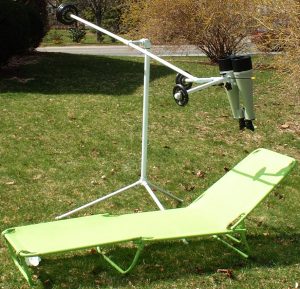
This year I’ve left the 12”LX200GPS at home in favor of the new 28x110 Garrett binocular on the EZ Binoc Super Mount. Several factors led to this decision.
1) I get plenty of eyepiece time at home on my 14”, and on this rare occasion when I’m under super dark sky I wish to enjoy naked eye and low magnification wide field views.
2) I do so much observing with my big Meade go-to SCTs that I miss the challenge of finding objects for myself.
3) It’s a 189 mile drive, and the 12” only fits in the pickup truck while the Garrett, the Gravity Chair and the Super Mount (broken down into sections) tuck neatly into the trunk of my Chrysler convertible. I’d rather make that lovely ride with the top down.

9 Aug 07 – This is the first year that the Springfield Telescope Makers have extended Stellafane into Thursday. And on Thursday night we have about 80% coverage by fast moving cloud that doesn’t allow enough time to observe thru the holes. We have approximately 12 members of ASSNE who arrived early, and we just sit in recliners guessing at stars as they wink in and out. A light rain occurs before morning.

10 Aug 07 – The rain has stopped by the time I roll out of my tent, and throughout the day the sky continues to clear as more ASSNE members arrive. Daytime temp reaches a humid 88°F. As darkness falls there is excitement across the hill as it will obviously be a clear dark night. Tonight’s anticipated 45°F temperature will certainly result in heavy dew, and the binocular has neither heater strips or dew shields. So I improvise dew shields using 2 fold out sky charts from two S&T magazines – forming them around the front of the binocular’s tubes and wrapping them with Tom's duct tape.

20:00 hrs. There’s a question as to what we’ll see first – Jupiter or Vega. Jupiter won hands down. I’m seeing banding and 3 Galilean moons.

The consensus on my area of the hill is to avoid premature “dew-up” by at least waiting until it’s dark enough to justify removing lens caps. So after peeking at Jup I cover the binoc up.

21:10 hrs. Although there’s still some twilight, the southern horizon here is very low and I’m seeing all of Scorpius including the lowest sections of the tail. In these conditions normally bright M4 appears as a dim irregular globular cluster. I’m resolving stars, but with the twilight conditions it could be much better.

21:20 It’s a wonderfully low southern horizon and I’m comfortably seated/reclining on the Gravity Chair after viewing M4, so I’ll just work this Messier rich area. Open cluster M6 (the Butterfly Cluster) is brighter, and globular cluster M7 is brighter yet. Or it’s getting really dark now.

21:24 M62 is a small globular cluster in Ophiuchus - E of Antares. I’m not at all familiar with Ophiuchus as it tends to be below my home horizon, and at first I’d identified this as M19.

21:29 M19 is a small dense somewhat elongated globular cluster situated above M62.

21:36 M22 is a big bright globular in Sagittarius. Being so low I usually can’t view this from my home observatory, and I’ve been missing something!

21:40 M8 (the Lagoon Nebula) is so bright in the 28x110s that it appears bigger than it actually is. Nice detail considering that I don’t have any filtration, but maybe filters aren’t as necessary under truly dark sky. And a dark sky it is. The Milky Way stands out in huge detail

21:44 M20 (the Trifid Nebula) is another extremely bright nebulosity just N of M8 and about ½ its apparent size. I’m searching several minutes for open cluster M21 to the NE of M20, when it occurs to me that M21 is actually the star grouping in the NE part of the Trifid.

22:09 M23 is a spectacular open cluster in the 28x110s. Sag is toward the center of the Milky Way and is certainly rich in nice Messiers.

22:12 M17 (the Eagle Nebula) has some small nebulosity centered around the bright stars, and it may just be moisture in the air that I’m seeing and not the nebulosity. The dew shields are completely effective, but the heat and moisture from my eyes is causing the eyepieces to dew up within about 5 seconds. The alternative to not viewing is to continuously wipe the eyepieces with a clean handkerchief.

Rather than star-hopping, I’m finding it most effective to carefully identify exactly where the sought object is located, and to put the 1X finder’s crosshairs on that spot. 9 times out of 10, the object will be in the fov.

22:20 M16 (the Swan Nebula) is really big and bright in my 14” scope, so I’m a bit disappointed to find it as small and dim and without form in the binocular.

22:30 M12 is another moderately bright globular in Ophiuchus. This area in toward the center of our galaxy is loaded with globes!

22:32 M10 is 3° E of M12 and a bit S. Another moderately bright globular.

22:47 Some of the guys are seeing M31 naked eye. The best that I can do naked eye is a star like object that is the very center of the galaxy’s core. In the binocular M31 is about 2° wide. I can easily see M101, but not M32. Bob Magnuson eyeballs it and claims M32. OK, I see it now. It's that fuzzy star.

23:06 The Double Cluster in Perseus is very much naked eye, and it’s SPECTACULAR in the 28x110s. This whole area of the Milky Way is packed with stars. But the double cluster is really brilliant.

23:33 It’s down to 52°F now. Heavy dew has shut down several ASSNE scopes. I’m starting to feel cold in spite of wearing 3 sweatshirts under a shell jacket. Q: What’s easy? A: M13 and its neighbor M92. These 2 globulars reside in Hercules and are easy to find in spite of lagging enthusiasm.

11 Aug 07; 00:26 hrs. My last object of the night is M15 – a very bright very small very tight globular in Pegasus.

Night’s summary: What a wonderful night. The dew shields worked wonderfully even if I had to constantly wipe the eyepieces dry of dew. I’ve learned my way around a few new constellations, and collected a bunch of Messiers that hopefully can be applied to the Astronomical League’s binocular challenge.

Saturday, 11 Aug 07

Some clouds give us a scare during the day and as night approaches. But as John Dobson concludes his address to more than 1000 attendees the sky clears nicely – and stays clear until past midnight.

21:01 Screwing around in the twilight with the 28x110s, a Galilean moon is starting to transit Jupiter, Albireo is nicely split and nicely colored, and M57 (the Ring Nebula) is visible.

21:15 The asterism in Vulpecula alternately known as The Coathanger, Collinder 399 and Brocchi’s Cluster is extremely bright and seems to fill the binocular fov.

21:34 M71 is a dim globular in Sagitta that is almost overwhelmed by the Milky Way.

21:39 M27 (the Dumbbell Nebula) appears surprisingly small at 28X – about the size of the smaller globulars. I’m used to viewing it thru the 14” at 200X.

21:47 Last night guys were seeing the North American Nebula naked eye. Straining with the 28x110 I can see faint nebulosity but no detail and I can’t tell where the North American Nebula ends and the Pelican Nebula begins.

22:08 Open cluster M11 (the Wild Duck) appears quite small but bright – almost as tight as a globular cluster at 28X.

22:23 NGC 6664 is a stellar ring, but part of the ring is very near non existent.

22:26 M26 is a small rather dim undistinguished open cluster in Scutum. Ho-hum.

22:30 Staying in Scutum, NGC 6712 is a small 8.1 mag globular about 10’ in diameter.

22:42 IC 4665 is a very open cluster in Ophiuchus consisting of about 14 bright stars in a 1° area.

Tonight we’re seeing numerous bright meteors with sparkling trails – right down the Milky Way NE to SW. Mark’s counting 3/minute, and the Perseids don’t peak until tomorrow night.

23:45 Everyone’s been exclaiming over the Veil Nebula so I’m going to give it a shot. I’ve got the Eastern Veil (NGC 6992, NGC 6995 and IC 1340). It’s very very dim in the 28x110s without filters, but I’ve confirmed it by area stars. I just can’t see NGC 6960 – the “Western Veil”. 6960 is what I think of as “the Veil”. It’s what I view with filters thru my scope. I easily identify the 5.2 magnitude star centered in 6960, but cannot see nebulosity.

12 Aug 07; 00:26 hrs. The Fairy Ring is a neat asterism of double stars a few degrees W of Sadr in Cygnus. To be more specific, its located 1.6° W of NGC 6888 (the Crescent Nebula). But the Crescent is hard to see with big scopes so this is just the nearest reference point on the star chart. Much much better than stellar ring NGC 6664, as there are at least 4 pairs of properly oriented double stars making up one half of the ring.

Night’s summary: Another wonderful dark night, although the darkness is lessening as time passes and moisture in the air increases. Caught 19 Messiers last night and 5 tonight without really trying, so that’s another 24 I can add to my AL binocular listing – if they’ll consider these monsters as binocular. The other stuff was usually much more interesting.
Neatest viewings were the meteors with bright sparkling trails, the Double Cluster and the Fairy Ring. This ring is something that I found in S&T, and isn’t listed in any object category.

Event summary: The Garretts were the right instrument to bring to Stellafane. Everyone who viewed thru them commented on their quality and on the exquisite views. ASSNE had some 21 members in attendance, and we had us a non-stop party. But I’ll leave that for others to post. This may be the first time anyone can remember when we had 2 good clear nights of Stellafane viewing.

Pete Peterson  13 Aug 07
Wishing Star Observatory
41°45'41.6" N
71°17'57.5" W

Return to EZ Binoc Supermount Kit webpage